Hamnet in Hollywood – Or, Everyone Dies with Shakespeare
The Thracian singer Orpheus fell in love and married his beloved Eurydice. The happiness of the newlyweds did not last long; the woman was bitten by a serpent in a meadow and sent to the afterlife. The widower turned into a mourner, endlessly singing minor notes in the impenetrable forests of Thrace.
"Who would fardels bear, To grunt and sweat under a weary life, But that the dread of something after death, The undiscover'd country from whose bourn No traveller returns, puzzles the will" (Shakespeare – Hamlet)
Bringing a human back from Hades to this world is something many characters have attempted, yet none have achieved success – the god Dionysus himself was mistaken, and the god's son Orpheus was mistaken too. To the widower who descended into Hades as a "borrower of life", the lord of the realm of the dead set a condition: you will save Eurydice from death if you lead her to the gates of life without looking back even once. Eurydice was made to follow Orpheus; he walked silently along the path towards life, reminding himself of the promise and pressing forward. However, he could not hear his bride's footsteps – in his agitation, his own heartbeat drowned out his hearing. Right at the threshold of this world, the widower turned around to behold Eurydice. Eurydice was engulfed by eternal darkness...
The story of Shakespeare’s love begins with the narration of this ancient myth. The Chinese director, Chloé Zhao, does not choose this theme by chance to speak about the tragic writer's personal life. The creator’s aim is to describe the beginning of the Enlightenment era without betraying the principles of one of cinema's main genres – the melodrama. The mission is accomplished; the melodrama genre makes a successful return to cinema screens, and in 2025 Hamnet "triumphs" over films such as A Big Bold Beautiful Journey, Die, My Love, Eternity and others.
The motion picture is based on the novel written five years earlier by Maggie O'Farrell. In the film, fictional stories blend naturally with real accounts from William Shakespeare's life.
In Hamnet, the Irish actor Paul Mescal – whose ancestors, in all probability, rented potato-growing lands during the Elizabethan era from the moneylender Shakespeare – plays the role of the British writer. In the very first frame, the actor's full face creates an allusion to the portrait created by John Taylor.
"I have thought some of nature's journeymen had made men and not made them well, they imitated humanity so abominably." (Shakespeare – Hamlet)
Shakespeare, who paid off the debts of his glove-maker father, built a luxurious mansion in Stratford, interested the London bourgeoisie, and created the Globe Theatre – is envisioned by us as a bold, determined, fierce, and energetic man. This steadfast nature is lost in Paul Mescal's borderline serenity. The actor flushes only from time to time, in excessively emotional moments.
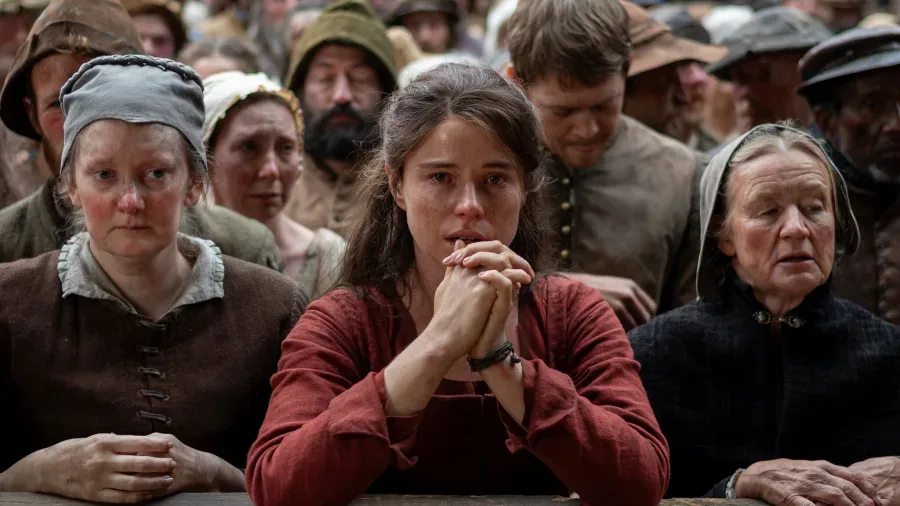
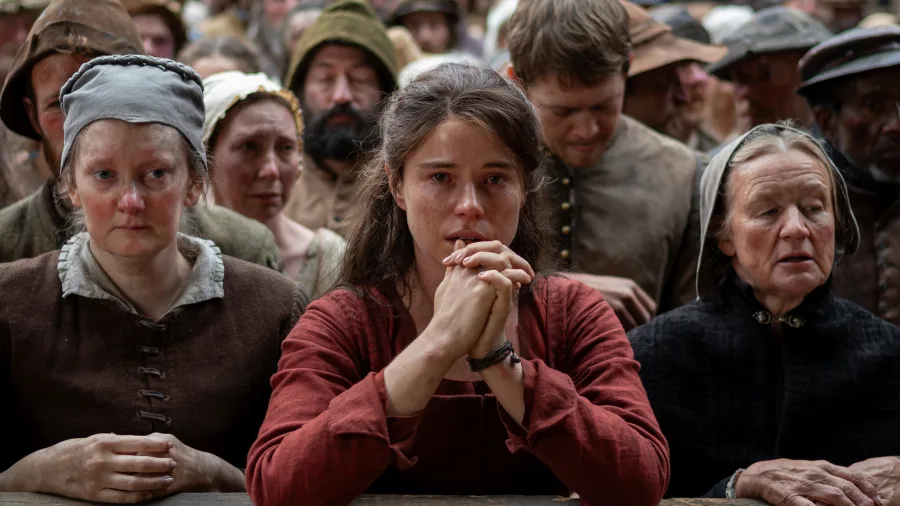
The film's main romantic line begins with the meeting between William and Jessie Buckley's character. The audience waits impatiently to hear the familiar name Anne – after all, Anne Hathaway was Shakespeare's only wife. Instead of the wife eight years his senior, whom the writer never truly loved in his lifetime, we see a woman named Agnes on the screen. Agnes's face fills William with the joy of love. Clad permanently in a red dress, the character is endowed with the knowledge of the language of nature. She wanders for hours in the forest, gathers plants, and flies her friend, the falcon. If she touches the palm of a person's hand, she can foresee their future as well. The woman often sleeps curled up by the roots of trees, and upon waking, she repeats a mantra learned from her mother; among the people, she earns – "deservedly" – the reputation of a witch.
The history of cinema proves that a certain kind of person – distinguished and learned – invariably falls in love with another who is entirely unusual and stands "far apart"; such unions undoubtedly end in marriage. The pregnant Agnes gives birth to her first child in the forest, completely alone. Shakespeare, previously enraptured by the power of love, is no longer satisfied even by the passion experienced through having a child. William has but one desire – to return to writing and lose himself in the search for the right phrase.
Agnes's unyielding character defines her dominance. Her decisions drive the film's plotline, much like Gertrude in Hamlet.
"Frailty, thy name is woman" – this Shakespearean quote from Hamlet suits Anne Hathaway far better than Agnes from Hamnet. Agnes is self-willed, but not a selfish person. Her unabated love for her husband prompts the pregnant woman to allow William to travel to London and work.
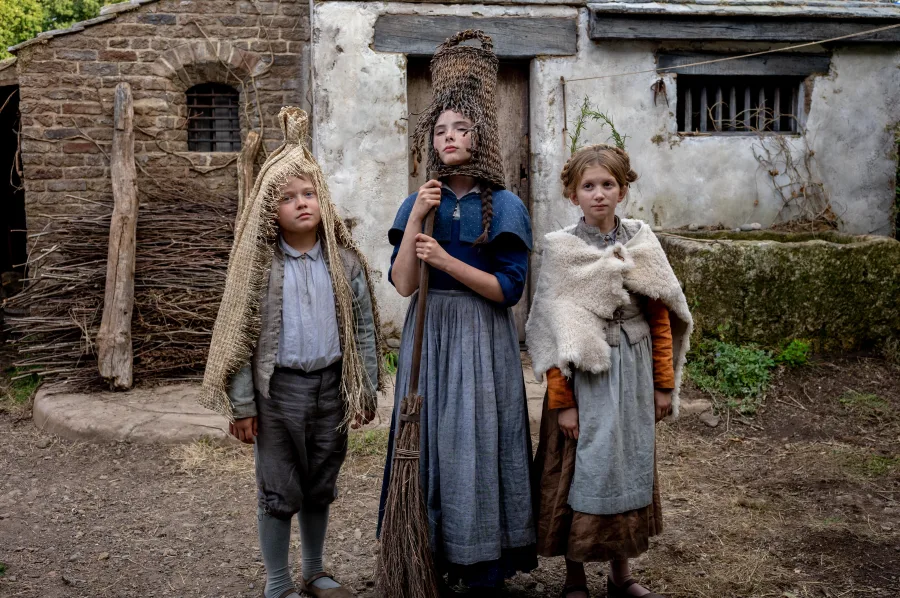
Mere patience and forgiveness are nothing; you must give something up, you must make a sacrifice. As a result of the woman's self-sacrifice, Shakespeare was born as a creator, but died as a husband. Agnes gave birth to twins, Judith and Hamnet, during which Shakespeare was not present, and she subsequently raised three children without a father's supervision. The "witch mother" saw her only two children by their deathbed in a vision, and after that, she fought every day for her children's lives.
Shakespeare's children, Judith and Hamnet, fell ill with the Black Plague raging in England at the time. The girl survived, whilst the family's only son, Hamnet, perished. Chloé Zhao captures the boy's death with an emotional scene – Hamnet, having sneaked into his dying sister's bedroom, tells Judith: "I will sleep with you tonight; when Death comes, he won't be able to tell us apart, he will mistake us for one another and take me instead." Hamnet deceived death and saved her, whilst he himself died in agony at the age of eleven.
If Agnes had been loyal to her husband prior to her son's death, the loss transformed her attitude towards William. The woman's love instantly turned into insurmountable loathing, because the man did not visit his dying son, whose last words were: "Father, I promise I won't be afraid, I will be brave."
Beyond fiction, in the real world, the play Hamlet was written between 1599 and 1601. It was customary for the British playwright to interpret already existing texts or historical facts – Hamlet was no exception. Prior to Shakespeare, the character of Hamlet is encountered with Thomas Kyd, in Saxo Grammaticus's historical narrative Gesta Danorum, and also in the Scandinavian epic under the name of Amleth. As for the playwright's son, he did indeed die at a very young age in 1596. According to rumours, the writer needed his pen to start life anew, to play out a real-life tragedy as a genre tragedy. Shakespeare blames himself for his son's death and writes with his own hand:
"Get thee to a nunnery: why wouldst thou be a breeder of sinners? I am myself indifferent honest; but yet I could accuse me of such things that it were better my mother had not borne me: I am very proud, revengeful, ambitious, with more offences at my beck than I have thoughts to put them in, imagination to give them shape, or time to act them in. What should such fellows as I do crawling between earth and heaven? We are arrant knaves, all; believe none of us. Go thy ways to a nunnery."
In Chloé's film, too, this passage resonates precisely through the playwright's tongue – at a rehearsal, Paul Mescal shows the actor playing Hamlet by example how to utter with genuine emotion the aforementioned "Words, words, words."
In the historical seventeenth century, the role of the "First Hamlet" was performed by Richard Burbage, whilst the Ghost of the Father was portrayed by Shakespeare himself.
At the film's conclusion, Agnes beholds her husband's work for the first time; she sees her son on the theatre stage, who was dead and has come to life, and she falls in love anew with the man who exchanged places with his dead son and descended into Hades. Shakespeare managed what not even the ancient gods succeeded in doing – he stole life from death.
"The rest is silence."