We Dreamt of Cabiria
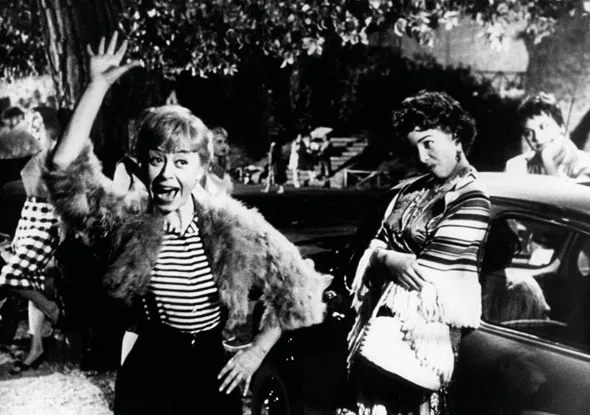
Between the midnight Neorealism of Italy and its dawning Surrealism lies that first moment of awakening—a moment reflected upon the faces of viewers like the light of Caravaggio. It is the first instant that fills the nightmare-stricken sleepwalker with the joy of being alive, planting in the heart an irrepressible desire to leap to one's feet and splash oneself with the fresh waters of the Tiber. In that single moment, hope flashes within the shell of the present, because the eye has caught sight of Cabiria's smile.
It is 1956. Federico Fellini, Giulietta Masina, and Pier Paolo Pasolini wander through the outskirts of Rome. Fellini observes women—their gestures, the length of their legs, the breadth of their hips, their nearly transparent faded striped dresses, their worn-down shoes, their precious fur coats destined to be passed down through generations. Masina is perhaps uneasy as she watches her husband, yet she is not angry. Pasolini's ears have become antennas; he listens to whispers, shouts, growls, barking, moans, gossip, and truth alike. He listens and writes it all down in his notebook, beneath a title written in large letters: The Dialects of the Suburbs.
Had Fellini not written sketches for Marc'Aurelio, he might never have named a prostitute from the outskirts of Rome—Cabiria. For Cabiria is also a mythological deity, ruler of the underworld, arbiter of destinies, keeper of secret rites, and thus immortal. Yet even without delving into Greco-Roman archives, cinema itself offers another clue: Cabiria was already the heroine of the great silent epic Cabiria (1914), a woman abducted during the Punic Wars who endures countless trials before finally attaining freedom. Whether this is sentimentality or the inspired intuition of a filmmaker, there is something enchanting in the notion that the world is simple, miserable, and unchanged: Cabiria is Cabiria in Greece, in the outskirts of Rome, and in ancient Colchis alike.

Since its inception, cinema has sanctified the faces of women with knitting baskets and men carrying newspapers—unless, of course, you object and remind me of those forgotten Italian fairy tales of white telephones. Fellini embodied Socrates' idea of the creator who can simultaneously produce tragedy and comedy. He rendered visible people who breathe, feel, suffer, and love. Viewers were moved by their purity and, before the screen, removed their hats as though entering a church.
The strange, beautiful creatures of Nights of Cabiria seem at once to run, stumble, and fly. They inhabit desolate landscapes, scattered among stone shelters sprouting from barren ground like mushrooms. Nothing about this place suggests spiritual purification. On the contrary, one would hardly imagine that angels might walk here upon the earth.
And yet, and yet—the human soul has no handle by which one may open it and peer inside. For that, one requires observation, a measure of thought, and a little imagination. Allow me to disappoint you: dialogue alone is not enough to recognize the downtrodden. We must cling to their slips of the tongue, their cries, the sounds they mutter in drunkenness.
"As fire tests gold, so adversity tests the strong man," wrote Seneca. Fellini's film begins with misfortune bordering on tragedy. Cabiria's beloved—her darling, her heart's desire—throws her into a river for a handful of coins. Swept away by the current, Masina's character must either await a miracle from God or hope for a few idle young men skilled in swimming. Which of these narratives seemed more appealing to a society emerging from Neorealism, I leave for you to decide.
Adversity tests Cabiria as well, and then fate grants the woman who has brushed against death a miracle. Late at night, separated from the sharp-browed women hunting in the darkness, the wandering soul Maria drifts into the center of Rome. There she is "awaited" by the movie star Alberto Lazzari. If fantasy it is, let it be fantasy—for this plot surpasses even Bollywood. Our cinematic prince quarrels with his long-legged fiancée and decides to spend the night with little Cabiria.
Life is an unbelievable tale. Here dreams become reality, though reality's dullness strips even dreams of their expensive makeup.
Cabiria opens her heart to the heartbroken star. An artist, after all, ought to be elegant, charming, intoxicating, radiant and beautiful; he ought to understand suffering like a prophet and offer life-giving compassion to the helpless. Perhaps this is true, perhaps it is not. One fact remains: the melancholy whims of the privileged are deemed far more valuable than the despair of a woman whom life has cast aside. Still, Cabiria obtains an autograph—a token sufficient to sustain faith and imagination within an oppressed soul.
"Now I need speech, heart, and art." A person blessed with an angelic essence journeys toward the Carnival of Angels to fulfill a debt before God by attending a religious celebration. Rome is clothed in Catholic devotion, yet do not trust your ears and eyes. Believe me, the desperate cry of the Italian who proclaims, "Holy Mary, your name is written upon my breast," deceives as much as it reveals. Do not be angry with them—or with me. It is a vast city, inhabited by people, not saints.
Desperate people begin to hope for miracles. Cabiria, too, takes refuge for several hours in the house of God, praying to be transformed and purified. Yet when she emerges from the sanctuary, she is met only by sameness. Nothing has changed. The sky remains the same, the grass remains the same, and wine remains wine, along with all its grace.
When torches are lit across the city, desperate butterflies emerge from their cocoons. At such an hour, the entrances to houses of illusion shine brighter than any other light. Seeking relief from sorrow, Cabiria turns toward the realm of illusion. Hypnotized, possessed by forces beyond the earthly, she surrenders to the frenzy of peach blossoms and becomes once more the long-haired maiden Maria. Within every corruption lies a hidden innocence, nourished by the expectation of love's miracle. The troubadour of love who inhabits her imagination bears the name Oscar—a name she reveals to the audience and to a handful of other dreamers without restraint.
"When you catch sight of a stranger passing along his own road, you leave a trace upon his destiny and alter something in his life. All the more so if you meet him, shake his hand, invite him into your home, speak with him. In short, a person is in your hands just as you are in theirs."
Oscar appears midway through the film as though stepping out of a dream into reality. By then, we are so captivated by Cabiria's innocent longing that we desperately want someone to choose her. We convince ourselves that someone has. Yet, alas, it is merely our own desire, colliding with emptiness and returning to us.
This was Cabiria's great love—so moving that it could never end happily. She sold her dwelling, which one should not call a home because no one awaited her there. She sold her possessions, removed her colorful nearly transparent dress, hung away the fur coat destined for future generations, donned a new cloak, slipped gloves onto her hands, and set off toward the cherished life she had dreamt of beneath countless moonlit nights. She carried with her her savings and the only photograph of her mother. In her heart she carried hope; in her soul, the child Maria—both sorrowful and carefree.
"Avoid everything your conscience disapproves of," wrote Romain Rolland. A single glance, standing upon a cliff above an unfamiliar shore, is enough for Cabiria to recognize in the man she loves the familiar face of corruption. In that instant, La Dolce Vita comes to an end.
Of course, Maria Cabiria Ceccarelli is robbed once again.
What remains for the woman traveling an unknown road, walking her own La Strada?
Only three words: faith, hope, and consolation—the consolation that accompanies life's carnival wherever it wanders.
Cabiria smiles at us and continues her journey.
She does not know where the road leads.
And yet she must follow it.